Showing posts with label environmental management. Show all posts

Monday, 6 August 2012

Australian "business as usual"

A recent commenter over at "the conversation" wrote what I happen to think represents a pretyy good summary of Australian Big Business attitudes.

So we slap a few PV panels on our open-cut mining equipment and maybe run our coal trains on recycled chip oil ... we know what we do here ... we dig stuff up and flog it overseas. The waggons leave full and come back empty. It's what we've always done.

We strip-mine the place - top-soil, water, forests ... you name it - it's all for sale. We improve nothing, we build nothing we live on what we've found. Our commitment to being clever peaked and faded after the triumph of the Victa lawnmower and the Hills hoist.

Our addiction to the myth of endless cheap power is the only reality we know. It's lasted a century. It must be eternal. We cannot imagine any life without cars of some sort, without switches and flying in our jet-lagged kiwifruit from Italy.

So we will blanket our landscape in CSG pipes and wind turbines. We will do whatever it takes to be comfortable and have some machine do all our work for us, to keep on consuming everything and producing nothing until, like a larger version of Nauru, all the stuff we've found here has been flogged off.

You have found small to medium businesses in Tasmania willing to invest in new technology, in new power, in making stuff? Really? Here in Australia? We don't do that here mate. It's like asking locusts to leave something for their kiddies.

Not saying we can't. Just that we won't
.


He made further clarification on some points here:


That living "in the bush" is not a viable alternative option. Not for everyone. Not for their entire lives. People get old and tired and need to be closer to the towns. And the actual costs of going it alone - even as a group - are prohibitive, ecologically and financially.

I have learned that many older "hippies" had set aside the permaculture adventures of their youth and were living essentially suburban lives on 1,000 hectare community titles.

That they burned just as much diesel as the local farmers and were dependent on an income from work, commuting 30ks each way (sound familiar?), that their verandahs were covered with enough lead acid batteries to sink an aircraft carrier and their fading utopia was drowning under the weight of lantana, their escaped garden plants and Bell-bird associated die-back.

The other thing - perhaps the underlying driver for a lot of this - is that while the kids and grandkids of these "hippies" often came back for visits - they all wanted to live somewhere else - in town, at jobs, and also leading very suburban lives. There was a diminished pool of fit strong labour - hence the increasing use of diesel.

But also the PV systems - which were HUGE and State of the ART - would hop the fence after 3 days of grey skies. No grid. So on goes the Genny... pop pop pop all along the valley.

Now 40 or so households all had $20,000 worth of gadetry slapped on their roof - and all up they had a total of three days worth of power. Absurd economics when you add it up.

A lot of the problem is that they half-did stuff right at the start. They paddled their own canoes. The available technology was not designed for more community-based notions of energy supply. It still isn't by and large. But also there were limits on the extent to which they would - or could - live in a "community" - they all wanted their own bush hideaway, or that's how it has ended up after 40 years.

So to summarise, the notion of going it alone is not in fact sustainable - not physically, not socially and certainly not economically. That doesn't mean we don't do things differently and better, but alternatives need to be more than just youthful adventures. Long-term, stable, as self sufficient and productive as possible, and somewhere where diesel is forever banned. Oh yes and learn to manage the bloody landscape while it's still there.

The one thing I have taken away from the bush is that small regional towns are a far more interesting prospect when it comes to building medium scale, long term alternatives. I'm still learning how to do that.

Incidentally the Carbon Price and subsequent trading system is very clever... probably too little too late for mine ... but very very much an Australian approach - not an import at all. And clever. Just not big and hard enough to effect enough change in enough time to avoid anything ... but let's see
.


Well worth reading is this bit of information about bell bird dieback.

Wednesday, 6 July 2011

populate or perish: how its destroying Australia

abstract


Australia is a unique and delicate environment. This is often hidden by the harsh conditions which will kill you if you don't know what your doing. Gradually Australians have come to understand this and come to know and love their country. However this is turning around and I have seen quite significant reversals of comprehension and understanding of Australia and its environment in the last 20 years. At the same time the levels of / and nature of environmental destruction have not really abated.

The preservation of our natural beauty, our native flora and fauna and the proper management of our key natural resources (not just plain exploitation) depends not only on the government, but on the understanding of and engagement with this by the public. We are a democracy so the government is steered by the public.

In this article I try to present one aspect of the reversal of positive trends in this area and put forward what I see as being core factors.

Since settlement of this country the purpose of government here has been the exploitation of resources to make (in the first instance) a self sustaining penal colony, making a profit for England and eventually (after federation) it remained in that mode of shovel it out the door to the 'stakeholders'.

Untold areas of land were altered by land clearing, deforestation, farming, irrigation and other practices.

During the about the fifties we began a paradigm shift of mentality from Australia being "a strange place we find ourselves in" to "my homeland which I know and love". In that period a generation of people were born who's parents did not regard somewhere else as being where they come from, but that Australia was where they come from. People like Len Webb became interested in observing what we were doing wrong with the management of our land and became interested in saving it. This became known as the environmental movement.

I encourage you to take a moment to examine some of his photographic documentation works at Griffith University's collection here. It could be argued that from the early Governors of the colony of NSW sought to protect this land, but the movement to protect the environment among the people only really took hold in the generatoin born after the 50's.

Recently the movement of environmental protection has been derailed and become an agenda of social reforms and conflicting ideology which seems to fail to engage the public as once did the bid to save the Franklin River campaign. Indeed the slogan of no dams has morphed subtly to remove the idea of it being within world heritage areas in South West Tasmania.

Since the 70's and 80's the importance of the environment to Australians has passed its peak. We see now in the 21st Century that interest in Environmental issues, people are now no longer worried about the Australian environment, its degradation and losses of land.

I feel there is substantial evidence to support that part of the reason for this is that more and more the public know less and less about Australia in large part because less and less of the Australian public are from Australia.

discussion


A quick read of Australian history reveals we've changed substantially as a nation. Starting with the settlement we were at first just a colony of immigrants.

While the contribution of immigration to what represents Australian culture and our society, there comes a point where if we bring people in fast enough it creates a level of social turmoil (apart from the normal growth dynamic of any society) and "turning the cement forever will just result in stuff which will never set". In this discussion I will attempt to demonstrate that after starting out as an infant nation sometime during the building of it we have made wrong choices which I feel are detrimental to the ongoing strength of Australia.

After the cessation of Convict labour in the 1840's, our immigration levels slowed and we started to take on the character of an infant nation. People like Henry Parkes began pushing for the unification of the colonies and the formation of a nation and by 1901 we had become a federated nation and started down the path of becoming a country in our own right.

Clearly we were a migrant based nation at that time, but its important to observe that we were growing in population AND importantly growing in population of people who were born here. It is this point which I consider of greatest significance, as the longer you are here the more you are likely to feel that this place is your home and not look at it as simply a place to screw over to take your money home with you.

Some time shortly after WW2 we began a serious intake of migrants, which (perhaps) was based on the belief that we needed to have a larger work force. One of the men in government at that time was Arthur Calwell, who believed strongly in the need to increase our population. He pioneered the "Populate or Perish" theme which became embedded in the machinery immigration policy.

Poaching words from Wikipedia (because you can't be sure that doesn't change) Arthur:

... Calwell overcame resistance to mass immigration by promoting it under the slogan "populate or perish". This drew attention to the need, particularly in light of the recent war in the Pacific, to increase Australia's industrial and military capabilities through a massive increase in the population.

I'm sure he was a well meaning fellow, but I believe that the mechanisms he put in place have ultimately provided for the destruction of what is Australia and what is important to us.

There is an old adage "divide and conquer" and perhaps the surest way to divide a people is to bring in new ones all the time. I believe that the Populate or Perish policy did exactly that.

As you can see from some data the results of this policy has been the increasing decline of the population of Australians who were born in Australia with a steady stream of migrants. Looking at this ABS document we can see quickly that from about the time of Federation we became increasingly a nation of migrants ...

Fig 4.2 Australia's population born overseas(a)(b)


with (at the time of Calwell) something like 10% of Australians being born overseas. This of course means that 90% of Australians were born here.

Australia became a federated nation (not just a bunch of colonies) on the first of Jan 1901 (the first day of the twentieth century) and marked a time when Australians were wanting to become Australian. At that point in time the population was still something like 20% migrant, but it was turning around with increasingly more and more people living here who were born here.

The results of the immigration policy was to begin adding quickly to the size of the population. Which was just as it was intended. This can be seen clearly in this population graph below.

population

However as seen above it also returned the trend away from Australians being people who are born here to increasingly people who have moved here within their lifetime. Perhaps this is the fastest growing national population in the developed world and perhaps also the fastest changing one too.

Change is a double edged sword, as it brings both good and bad.

As a country we have very high urbanization, and interestingly it seems that the migrants who come to Australia prefer to live in the cities with "eight out of ten people born overseas lived in a capital city. Just over half were in Sydney or Melbourne"(source abs).

Which in my view can only increase the distancing of Australians from really understanding Australia. People who live in big cities (and make no mistake, cities now are quite different from cities at the beginning of the 20th Century) are more likely to have disconnected and partially formed grasps of reality.
Its not unusual for city people to
  • not know where water comes from,
  • not know where sewerage goes or how its treated
  • not know where food comes from
  • not understand much at all about food
  • be filled with unreal contradictions For instance "I want to eat meat, but killing an animal to eat it is disgusting"
No wonder less and less we see anyone give a shit about the degradation of the Australian landscape and the effects of pollution. Instead everyone goes on about CO2 as if its the main issue while benzene and carcinogens are poured into the air and water.

Because increasingly they come from elsewhere, live in the big city and have no kinship with the country people don't look at the landscape and see degradation. To see that you would need to have understood what it was 15 years ago, which you can't if you don't live in the area long.

It becomes more interesting when you look at where migrants live. For example according to (slightly old) ABS data Queensland has the greatest amount of the population who were born in Australia and WA has the highest.
STATE POPULATION DISTRIBUTION - 2001


Which is interesting, as Queensland seems to be the area where people born in Australia from Sydney and Melbourne come to to retire. Often because they're sick of the rat race and in search of a nice place to live.

Australia it seems is decreasingly interested in preserving the environment or addressing issues such as the rates of land clearing. I'm certain this is linked with both urbanisation and the increasingly migrant itinerant population.

Back in the beginning of the 20th Century while many Australians lived in towns, they were smaller towns and (relatively) many more people lived in the regional areas or even had family who still did.

Now its totally different and the gap between the 'bush' and the 'city' is widening.

With changes in what is the nature of migrants (like why did they come here) altering from "a place to live" to "a place to improve our earnings" and the social background they come from (was UK and Europe is now more broadly Asia) I think its unlikely we'll ever have such a strong core of people who shared the values of those who founded the country.

I'm not sure if its possible to turn this around, but it will take years for us to get back that critical mass of people born here and who regard this as their homeland and have enough knowledge of it to know what they're talking about.

Tuesday, 9 March 2010

housing bubble or population trouble

There is often talk of a housing bubble in Australia, and comparisons made to the USA. However a fundamental difference is ignored, which is that the population growth is quite different between the two locations.

Australia has significant population growth which can only do one thing when it come to housing: require more of it.

Some sources suggest that our population is "growing the fastest since the 1960s and double the global average. Net immigration accounted for two-thirds of this people boom".

According to that we had 511,000 new arrivals last financial year. Give or take, that's a population the size of the Gold Coast just sprouting up.

No wonder there is pressure on housing. I heard recently from a friend of mine that its common practice in some parts of Australia for landlords to require 4 months rent in advance on propertys.


There is the viewpoint that we need to grow our population in Australia, this seems popular among the 'leadership' who live in cities and seem to be unable to grasp the broader issues.

Land clearing causing destruction of Koala habitat in the name of further urban sprawl are simply "problems" which need creative solutions. The trouble is that there are usually no solutions and problems roll and expand on while lots of hot air gets expelled discussing "we need to solve these problems".

This seems to be creating a groundswell of 'grass roots' negativity expressed in the "fuck off we're full" stickers adorning the bumpers of "utes". While this is hardly helpful, it is a strong indicator of problems.

This is the growth in the population of 3 major cities since between 1911 and 2001.


3AussieCitiesPopThese three cities account for nearly half the Australian population.

To explain the graph a little I put Brisbane on a different scale to the others because unlike Sydney or Melbourne (which over the period have increased in population by around six times) Brisbane has had its population grow by nearly twelve times since 1911 (From 139,480 to 1,650,422)

This represents a startling management challenge, which I think anyone who lives in these cities may feel has not been entirely well performed.

Also, anyone who lived in any of these cities has seen amazing changes in how life is in those cities every 10 years.

When I moved to Brisbane in 1983 it was a nice but largeish country town. There was not insane traffic and you could get out into the countryside quite easily.

At that time the population was 1,028,527 ... but when I left in 2001 it had swollen to 1,619,280 and you could really notice the difference. Traffic was worse, public attitude was more strained and road rage and other less than ideal social problem was on the rise ... so lifestyle was certainly not better.

I imagine Sydney has undergone similar changes (although perhaps not as straining as Brisbane), and watching any movie filmed on the streets of Sydney in the 1980's reveals quite a difference.

But I wonder if this is in our interests in Australia ... I mean really.

Firstly Australia has a really poor record of environmental management, and I'm not just talking about how we manage our natural heritage (which should be a national shame), I am talking about how we've been managing our agriculture and forestry practices. Look at the Murray Darling crisis for just a start.

Our politicians espouse protecting our lifestyle, but seem to be busily facilitating its erosion.


If you like fishing, you can kiss good by to this area as the great fishing spot it once was ... mangroves are going and so too are the breeding grounds for fish. Not to mention the increased pressure on fishing created by the increasing population. As boat traffic is manic (along with the jetSki's I can't even enjoy sailing there anymore.

The urban sprawl is encroaching inland too, and what were previously lovely areas (habitat for wildlife) are being cleared to become just another urban wasteland.

Its like this all up and down the coast, from Coffs Harbour to Rainbow beach. Matter of fact its pretty built up between Coffs and Sydney ... and I'm willing to bet its not empty between Sydney and Melbourne?

Used to be that my family and I could live in a place where we could go fishing and enjoy walks along the shore.

Photographs like this were of a lifestyle we enjoyed as recently as 10 years ago, but is now fading into memories.

Once we could find wildlife not far from our homes ... now we seem to live in urban enclaves which have streets that are empty of humans and are filled cars instead. This has a number of impacts, including that our children can't ride bicycles to school and mum needs to start the Prado up to take them 2Km to school.

Sights like this emu walking along a country road (once familiar to my parents) are almost impossible to see.

gone

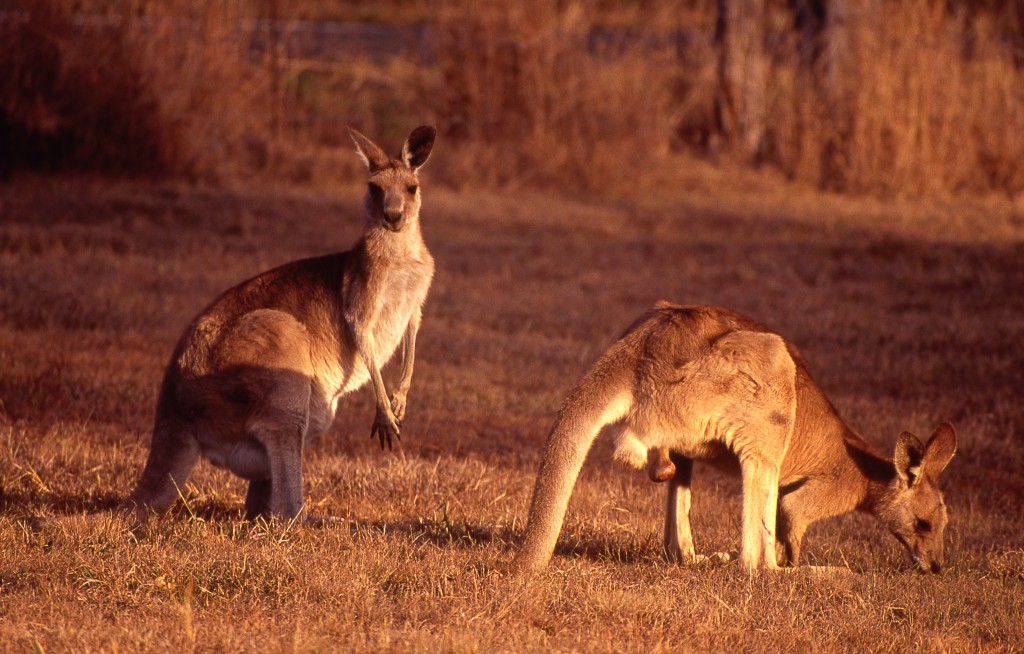
this image was taken in a park just out of Ipswich ... there will not be any Roos there now as its in the middle of an urban sprawl now.

2Roos

Our lifestyle is fast disappearing ... my question is

"what are we doing to ourselves and for what benefit?"

Thursday, 24 September 2009

Dam crazy - part 1

when is enough enough


John O'Grady once wrote a book called "they're a weird mob" I think an appropriate sequel today would be "they're dam crazy people"

Let me start this post with a quote from a paper on "FLOW RESTORATION AND PROTECTION IN AUSTRALIAN RIVERS" published in 2003

"Since 1857 new Australians have constructed many thousands of weirs (3600 in the Murray-Darling Basin alone) and floodplain levee banks, 446 large dams (>10m crest height) and over 50 intra- and inter-basin water transfer schemes to secure water supplies for human use."

So we've been building more dams than a family of beavers and we still haven't got enough water? Leaving any theory out of this and just looking at this in a "black box" way it is pretty apparent to the most common person in Australia that banging the same drum is not going to produce a solution.

Instead, all that seems to have resulted from that is increased spending, increased requirement of management and increasingly degrading our environment.


Despite these negative effects our government seem "hell bent" on pushing through the same strategies which have been shown to be inadequate and not provide sustainable answers to the question.

It seems that no matter how much we build dams we're always playing a game of catchup, but its now getting worse as now (due to the expansion of our population and urban sprawls) we find that we're rapidly running out of locations where we can actually put a dam without needing to drive people out of their homes or flood productive grazing and farmlands.

Actually this isn't a new phenomenon, back in the 1970's in the Gold Coast hinterland a small town in the Numinbar valley was "resumed" a dam built and the valley flooded. This dam was the Hinze dam and it served the population of the Gold Coast well for over 20 years.

But in the scale of things 20 years isn't really a long period and now the population is living on a dependency of "good years" of rainfall as it was shown in 2003 that if there is just 2 years of low rainfall that the dams run very close to failing to meet demands.

In fact if it was not for the evocation of water restrictions (close to martial law) on the population its certain that the dams would indeed fail.

This image was taken from a locatoin well below the ideal water line of the Hinze dam during the water crisis of 2003, and infact the dam got so low that some of the traffic signs from the immersed town began to appear.

Chicken little cry of "drought"


There's a drought there's a drought... The common thing is to blame this on drought and suggest that we're in the grip of the worst drought in living memory or some such nonsense. The solution to the problem is often ingeniously put forward that: we need to (wait for it ... drum roll) build more dams to drought proof the region.

Gosh ... that hasn't been tried before. Actually we've been trying to "drought proof" ourselves by building dams since the beginning of the 20th Century. Melbourne Water even has a nice reference to this on their history page.

We all know that Australia is a dry country, from the poems of Dorothea Mackellar through surveys as done by our early pioneers (Goyder) to our iconic images, we know we are intrinsically a dry land with limits to our water supply.

So why is it then that lack of rain is a "surprise" when it happens?

Short memory or media created social belief?


Perhaps its down to our short memories, perhaps because we're all so media fed we've forgotten how to remember ... I don't know. There seems to be a case however, that people believe what they're told and the the group believes what the group leaders tell them is true.

Firstly lets look at some data. Below is a chart showing the rainfall at Southport for around 100 years.

Two things are clear looking at this graph; firstly there are some serious spikes in the rainfall history with a big spike in around 1976 (when we had our worst flooding on record) and secondly that there is an overall trend up in rainfall around the middle of the period.

This data amount is short really (after all its only a hundred years) but it could well mean that its been drier than it has been in the last 50 years and that its a little early to be wondering if this is climate change or some other trend.

So what's changed?

Part of the problem is that the population goes up as 1) we move more people into our cites from the countryside 2) our population in Australia grows.

To take things from the general to the specific, lets pick a case study.

The Gold Coast and Brisbane represent a large fraction (like most) of the population of South East Queensland.

Since 1960 the population has grown to nearly 10 times its number, so when the Hinze Dam was being planned I think its fair to say that no one was thinking that the population would grow to around half a million people. Especially since at the time there was the "Little Nerang Dam" which was built just a few years earlier to supply the region.

Looking around at the topography there are not many clearly obvious sites for another dam, the ranges are close. Have a look around your self...


View Larger Map

go much further west and its too dry, go much further north and you hit Brisbane.

With more and more pressure (may someone please tell me why and where it is comming from?) to move to the area there is pressure to build more dams. Currently there is some targeting of the Mary river around the north side of Brisbane but there is strong opposition to that for a number of good reasons.


Planners seem to be bent on more dams as the solution to the problem (despite it not having solved it yet). There have been quite a many proposals for Dams in the South East Queensland regions which have either been scuttled, shelved, renamed or on the go.

But it continues to look bad for dams as if its not public opposition it internal problems. For example one of the requirements for a project these days is (thank god) that there must be an economic fesability study done to demonstrate that the project is justifiable. This seems to be quite an obstacle, as it is seldom found that the dam will provide water at a price which the market will accept.

For example One study done for the government into a previous dam proposal (Paradise Dam) suggests that it will not be economically viable and that water needs could be met with alternatives.

Alternatives ...?


You mean there is an alternative to building more dams? One thing is for sure, while we may have had droughts in the past we weren't as reliant on dams as we are now. In fact I'm not even entirely sure that they make good sence in our environment / geography / climate. The idea after all has come from Europe, where topography similar to the (quite successful) Little Nerang Dam exists.

You don't have to look far in outback Australia to find a house with a tank on the side to store rain water.

Now before you get steamed up on the problems with tank water I'd like to point out something important... diversity.

Something which seems to have come from the modern world is the destruction of our understanding of diversity of supply. We get all our water from reticulated water supply, we buy everything in Shopping Malls, we all seem to get our ideas from TV ....

Think about it ... Do you eat only one thing?

Like do you eat only bread or only meat?

Having a rainwater tank adds to your houshold water supply, you may not want to drink it, but do you really need to be flushing your toilet with water treated to high "drinking water quality" standards?

In part 2 I would like to present more about the alternatives and explain more on why I just don't get the Australian (government) mentality towards dams.