Showing posts with label lifestyle. Show all posts

Wednesday, 6 July 2011

populate or perish: how its destroying Australia

abstract


Australia is a unique and delicate environment. This is often hidden by the harsh conditions which will kill you if you don't know what your doing. Gradually Australians have come to understand this and come to know and love their country. However this is turning around and I have seen quite significant reversals of comprehension and understanding of Australia and its environment in the last 20 years. At the same time the levels of / and nature of environmental destruction have not really abated.

The preservation of our natural beauty, our native flora and fauna and the proper management of our key natural resources (not just plain exploitation) depends not only on the government, but on the understanding of and engagement with this by the public. We are a democracy so the government is steered by the public.

In this article I try to present one aspect of the reversal of positive trends in this area and put forward what I see as being core factors.

Since settlement of this country the purpose of government here has been the exploitation of resources to make (in the first instance) a self sustaining penal colony, making a profit for England and eventually (after federation) it remained in that mode of shovel it out the door to the 'stakeholders'.

Untold areas of land were altered by land clearing, deforestation, farming, irrigation and other practices.

During the about the fifties we began a paradigm shift of mentality from Australia being "a strange place we find ourselves in" to "my homeland which I know and love". In that period a generation of people were born who's parents did not regard somewhere else as being where they come from, but that Australia was where they come from. People like Len Webb became interested in observing what we were doing wrong with the management of our land and became interested in saving it. This became known as the environmental movement.

I encourage you to take a moment to examine some of his photographic documentation works at Griffith University's collection here. It could be argued that from the early Governors of the colony of NSW sought to protect this land, but the movement to protect the environment among the people only really took hold in the generatoin born after the 50's.

Recently the movement of environmental protection has been derailed and become an agenda of social reforms and conflicting ideology which seems to fail to engage the public as once did the bid to save the Franklin River campaign. Indeed the slogan of no dams has morphed subtly to remove the idea of it being within world heritage areas in South West Tasmania.

Since the 70's and 80's the importance of the environment to Australians has passed its peak. We see now in the 21st Century that interest in Environmental issues, people are now no longer worried about the Australian environment, its degradation and losses of land.

I feel there is substantial evidence to support that part of the reason for this is that more and more the public know less and less about Australia in large part because less and less of the Australian public are from Australia.

discussion


A quick read of Australian history reveals we've changed substantially as a nation. Starting with the settlement we were at first just a colony of immigrants.

While the contribution of immigration to what represents Australian culture and our society, there comes a point where if we bring people in fast enough it creates a level of social turmoil (apart from the normal growth dynamic of any society) and "turning the cement forever will just result in stuff which will never set". In this discussion I will attempt to demonstrate that after starting out as an infant nation sometime during the building of it we have made wrong choices which I feel are detrimental to the ongoing strength of Australia.

After the cessation of Convict labour in the 1840's, our immigration levels slowed and we started to take on the character of an infant nation. People like Henry Parkes began pushing for the unification of the colonies and the formation of a nation and by 1901 we had become a federated nation and started down the path of becoming a country in our own right.

Clearly we were a migrant based nation at that time, but its important to observe that we were growing in population AND importantly growing in population of people who were born here. It is this point which I consider of greatest significance, as the longer you are here the more you are likely to feel that this place is your home and not look at it as simply a place to screw over to take your money home with you.

Some time shortly after WW2 we began a serious intake of migrants, which (perhaps) was based on the belief that we needed to have a larger work force. One of the men in government at that time was Arthur Calwell, who believed strongly in the need to increase our population. He pioneered the "Populate or Perish" theme which became embedded in the machinery immigration policy.

Poaching words from Wikipedia (because you can't be sure that doesn't change) Arthur:

... Calwell overcame resistance to mass immigration by promoting it under the slogan "populate or perish". This drew attention to the need, particularly in light of the recent war in the Pacific, to increase Australia's industrial and military capabilities through a massive increase in the population.

I'm sure he was a well meaning fellow, but I believe that the mechanisms he put in place have ultimately provided for the destruction of what is Australia and what is important to us.

There is an old adage "divide and conquer" and perhaps the surest way to divide a people is to bring in new ones all the time. I believe that the Populate or Perish policy did exactly that.

As you can see from some data the results of this policy has been the increasing decline of the population of Australians who were born in Australia with a steady stream of migrants. Looking at this ABS document we can see quickly that from about the time of Federation we became increasingly a nation of migrants ...

Fig 4.2 Australia's population born overseas(a)(b)


with (at the time of Calwell) something like 10% of Australians being born overseas. This of course means that 90% of Australians were born here.

Australia became a federated nation (not just a bunch of colonies) on the first of Jan 1901 (the first day of the twentieth century) and marked a time when Australians were wanting to become Australian. At that point in time the population was still something like 20% migrant, but it was turning around with increasingly more and more people living here who were born here.

The results of the immigration policy was to begin adding quickly to the size of the population. Which was just as it was intended. This can be seen clearly in this population graph below.

population

However as seen above it also returned the trend away from Australians being people who are born here to increasingly people who have moved here within their lifetime. Perhaps this is the fastest growing national population in the developed world and perhaps also the fastest changing one too.

Change is a double edged sword, as it brings both good and bad.

As a country we have very high urbanization, and interestingly it seems that the migrants who come to Australia prefer to live in the cities with "eight out of ten people born overseas lived in a capital city. Just over half were in Sydney or Melbourne"(source abs).

Which in my view can only increase the distancing of Australians from really understanding Australia. People who live in big cities (and make no mistake, cities now are quite different from cities at the beginning of the 20th Century) are more likely to have disconnected and partially formed grasps of reality.
Its not unusual for city people to
  • not know where water comes from,
  • not know where sewerage goes or how its treated
  • not know where food comes from
  • not understand much at all about food
  • be filled with unreal contradictions For instance "I want to eat meat, but killing an animal to eat it is disgusting"
No wonder less and less we see anyone give a shit about the degradation of the Australian landscape and the effects of pollution. Instead everyone goes on about CO2 as if its the main issue while benzene and carcinogens are poured into the air and water.

Because increasingly they come from elsewhere, live in the big city and have no kinship with the country people don't look at the landscape and see degradation. To see that you would need to have understood what it was 15 years ago, which you can't if you don't live in the area long.

It becomes more interesting when you look at where migrants live. For example according to (slightly old) ABS data Queensland has the greatest amount of the population who were born in Australia and WA has the highest.
STATE POPULATION DISTRIBUTION - 2001


Which is interesting, as Queensland seems to be the area where people born in Australia from Sydney and Melbourne come to to retire. Often because they're sick of the rat race and in search of a nice place to live.

Australia it seems is decreasingly interested in preserving the environment or addressing issues such as the rates of land clearing. I'm certain this is linked with both urbanisation and the increasingly migrant itinerant population.

Back in the beginning of the 20th Century while many Australians lived in towns, they were smaller towns and (relatively) many more people lived in the regional areas or even had family who still did.

Now its totally different and the gap between the 'bush' and the 'city' is widening.

With changes in what is the nature of migrants (like why did they come here) altering from "a place to live" to "a place to improve our earnings" and the social background they come from (was UK and Europe is now more broadly Asia) I think its unlikely we'll ever have such a strong core of people who shared the values of those who founded the country.

I'm not sure if its possible to turn this around, but it will take years for us to get back that critical mass of people born here and who regard this as their homeland and have enough knowledge of it to know what they're talking about.

Wednesday, 13 April 2011

migration pressure - knock on effects

Australia since the creation of a colony by the English has been as a bloody great place to come over to and see what you can rip up and take away. Some people started doing this back in the earliest days of the colonial period of Australia.

Recently I wrote about the effects on population created by changes in immigration

population

Its interesting to see that at the same spot where the population growth started to ramp up we see another trend observed by the researchers at Australian Bureau of Statistics ... that up until the 1940's Australia was increasingly populated by people born here. Then, after that point in time, ramping up the migration rate meant that less and less people who call themselves Australian are Australian born.

ABS has a very interesting page
click to read larger version

So at the moment around one in four Australians are born here ... and looking at the modern end of that curve, the trend seems to be continuing and perhaps increasing.

Now, its interesting to note that the real growth of interest in conserving and protecting (as opposed to chopping down digging up and outright exploiting) came from about the time when most Australians were born here. Its also interesting to note that there is a decrease in interest in environmental issues, and that the environmental party (the Greens) has become subverted away from the environment and become some sort of radical urban based party.

I put forward that this is caused by the increase in immigration. We have less and less people who really understand Australia and an increase in the changes to what Australia is.

By having an increasingly itinerant population is it any wonder that noone gives a rats arse that your home is being degraded?

Friday, 12 March 2010

growing pains

further to my recent question about the benefits of our national growth I see the that SMH reports that NSW may be forcing the market to move faster on making more room for people by forcibly acquiring private lands for resale:
THE state government is rushing to prepare laws to create a development authority with sweeping powers to compulsorily acquire and rezone privately owned land for resale to developers

looks like tough love from our Nanny who loves to protect us with laws. Its strange how I don't feel so protected. Well, anymore than my Aunt's sheep on their property feel protected by her.

Sadly I think that the machinery of Government is still following its colonial origins while the reality is we have not been a colony for a century.

Still, if the machine is not actually reprogrammed, it will keep following the sane program.

Its nice that you can't even keep your own land to yourself even if you resist the offerings of developers, to hold on to your bit of eden, they'll just take it from you it seems.

Ask the Aboriginals about it, we may be next (if we were ever regarded differently).

Tuesday, 9 March 2010

housing bubble or population trouble

There is often talk of a housing bubble in Australia, and comparisons made to the USA. However a fundamental difference is ignored, which is that the population growth is quite different between the two locations.

Australia has significant population growth which can only do one thing when it come to housing: require more of it.

Some sources suggest that our population is "growing the fastest since the 1960s and double the global average. Net immigration accounted for two-thirds of this people boom".

According to that we had 511,000 new arrivals last financial year. Give or take, that's a population the size of the Gold Coast just sprouting up.

No wonder there is pressure on housing. I heard recently from a friend of mine that its common practice in some parts of Australia for landlords to require 4 months rent in advance on propertys.


There is the viewpoint that we need to grow our population in Australia, this seems popular among the 'leadership' who live in cities and seem to be unable to grasp the broader issues.

Land clearing causing destruction of Koala habitat in the name of further urban sprawl are simply "problems" which need creative solutions. The trouble is that there are usually no solutions and problems roll and expand on while lots of hot air gets expelled discussing "we need to solve these problems".

This seems to be creating a groundswell of 'grass roots' negativity expressed in the "fuck off we're full" stickers adorning the bumpers of "utes". While this is hardly helpful, it is a strong indicator of problems.

This is the growth in the population of 3 major cities since between 1911 and 2001.


3AussieCitiesPopThese three cities account for nearly half the Australian population.

To explain the graph a little I put Brisbane on a different scale to the others because unlike Sydney or Melbourne (which over the period have increased in population by around six times) Brisbane has had its population grow by nearly twelve times since 1911 (From 139,480 to 1,650,422)

This represents a startling management challenge, which I think anyone who lives in these cities may feel has not been entirely well performed.

Also, anyone who lived in any of these cities has seen amazing changes in how life is in those cities every 10 years.

When I moved to Brisbane in 1983 it was a nice but largeish country town. There was not insane traffic and you could get out into the countryside quite easily.

At that time the population was 1,028,527 ... but when I left in 2001 it had swollen to 1,619,280 and you could really notice the difference. Traffic was worse, public attitude was more strained and road rage and other less than ideal social problem was on the rise ... so lifestyle was certainly not better.

I imagine Sydney has undergone similar changes (although perhaps not as straining as Brisbane), and watching any movie filmed on the streets of Sydney in the 1980's reveals quite a difference.

But I wonder if this is in our interests in Australia ... I mean really.

Firstly Australia has a really poor record of environmental management, and I'm not just talking about how we manage our natural heritage (which should be a national shame), I am talking about how we've been managing our agriculture and forestry practices. Look at the Murray Darling crisis for just a start.

Our politicians espouse protecting our lifestyle, but seem to be busily facilitating its erosion.


If you like fishing, you can kiss good by to this area as the great fishing spot it once was ... mangroves are going and so too are the breeding grounds for fish. Not to mention the increased pressure on fishing created by the increasing population. As boat traffic is manic (along with the jetSki's I can't even enjoy sailing there anymore.

The urban sprawl is encroaching inland too, and what were previously lovely areas (habitat for wildlife) are being cleared to become just another urban wasteland.

Its like this all up and down the coast, from Coffs Harbour to Rainbow beach. Matter of fact its pretty built up between Coffs and Sydney ... and I'm willing to bet its not empty between Sydney and Melbourne?

Used to be that my family and I could live in a place where we could go fishing and enjoy walks along the shore.

Photographs like this were of a lifestyle we enjoyed as recently as 10 years ago, but is now fading into memories.

Once we could find wildlife not far from our homes ... now we seem to live in urban enclaves which have streets that are empty of humans and are filled cars instead. This has a number of impacts, including that our children can't ride bicycles to school and mum needs to start the Prado up to take them 2Km to school.

Sights like this emu walking along a country road (once familiar to my parents) are almost impossible to see.

gone

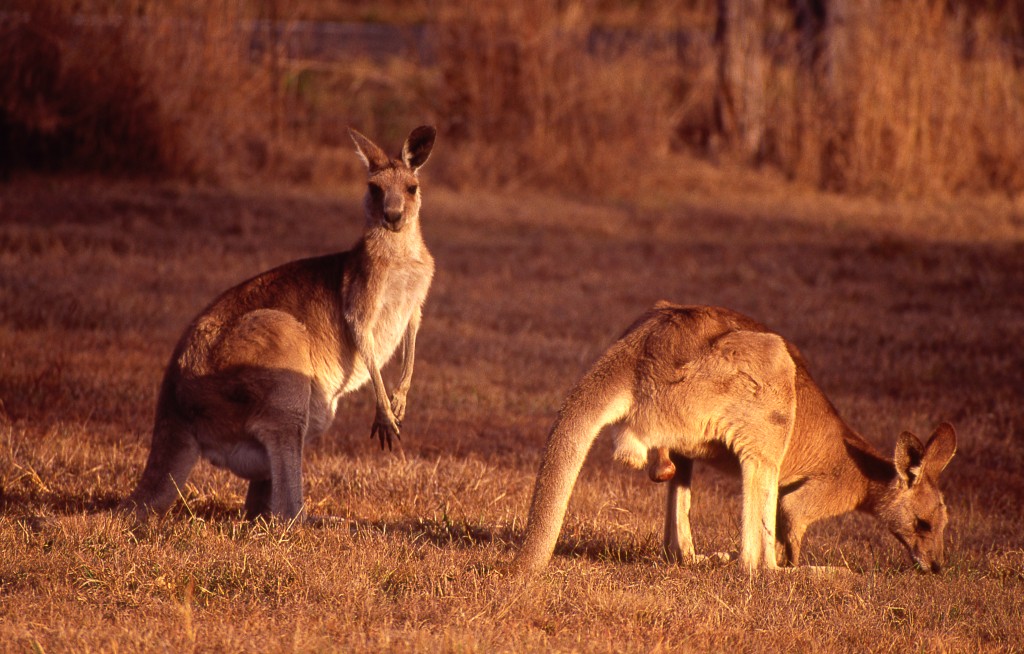
this image was taken in a park just out of Ipswich ... there will not be any Roos there now as its in the middle of an urban sprawl now.

2Roos

Our lifestyle is fast disappearing ... my question is

"what are we doing to ourselves and for what benefit?"

Monday, 21 September 2009

the population craze

When I grew up in South East Queensland it was a nice and quite place. Sure people ragged Brisso as being a large country town, but you could leave your back door open for days at a time and noone would rob the joint.

cityMtGravatTraffic was annoying, but not manic and there were nice places you could go to get away from people and stuff without going for a major journey.

Our "burbs" were leafy with the mountains in behind the city giving us an easy drive to nice cooler temperatures in the evenings and great views for having a picnic (should you be that way inclined)

But the writing was on the wall that all this had to come to an end some time (to quote Vin) with baby boomer mentality in our economics areas saying we should aim for a larger population.

Yep, you guessed it, references to the good olde US of A were cited as exemplifying how we should be and where we should go to ... Some idiots (Greg Sheridan comes to mind) even wrote of figures like 50 million.

A couple of days ago I read this article in the Australian, where the author suggests that the population of Australia may be as high as 35million in 40 years. Some salient points:

The new population estimate for 2049 is much greater than the 28.5 million Treasury projected just two years ago. The unexpected growth in the population will bring a modest 3.3 percentage point reduction in the number of people aged over 65 from the 2007 estimate of 25.3per cent. Mr Swan says the number of people aged over 85 will rise from 1.7 per cent now to 5 per cent over the next 40 years. This compares with an estimate of 5.6 per cent made in the last intergenerational report.


Holy Shit...

One of the reasons for encouraging growth has been to get more younger people here (to stem the problem of the aging population) and an attempt to get more skilled labour to fill the "skills shortage". I guess that while encouraging people to have more babies that immigration is the fastest way to get "skilled labour" in here. But do we really need this?


I would not be the only one to suggest that the skills shortage seems most acute in the Planning and Administration of this nation.

As it happens I've been out of Australia quite a bit in the last 10 years, with returns every couple of years and absences of a couple of years. Just like irregular visits to a friend with a young kid this really helps to me to see just how much growth is happening and how fast.

Lets have a look at what sort of growth we're talking about here.

Since around when I was born the population of (say) the Gold Coast has grown to nearly ten times its level.

That has to have an effect on any number of things, and lifestyle is certainly the one I think we notice first, and I don't think many would agree its getting better.

So when the Government says things like "protecting the lifestyle of Queenslanders" (for example) I wonder just who they are talking about, cos its not me!

So before we even get down to who's migrating here and what that means I think we should consider the effects of increased population on our lifestyle as that's quite significant.


When I was a little fella we could see dolphins and flocks of migratory birds on our beaches at the Gold Coast. It was a nice little village to live in.

These days you get to see more skyscrapers, development and all the 'buzz' that brings with it. Shootings and robberies seem to be more common news on the Gold Coast than in Sydney.


Is that Queensland lifestyle? Sure ain't this Queenslanders idea of such

yamba PoolTo 'escape' from this Florida Style highrise lifestyle these days I have to go far south or far north to get the same thing.

Even then its harder as Sydney is expanding more north, so Nth NSW is starting to become within reach of there more and more.

Living in dense urban conditions certainly isn't what I consider "Australian Lifestyle" to be.

Personally I prefer to be camping, or hiking, or exploring some coastline to perhaps do some fishing. Places like the quick video from the past is more where I consider I'll find "Australian Lifestyle"


But before you say it, yes we do need economic growth and prosperity. Strangely enough I am living in Finland right at the moment, where the population has remained at about 5 million since before World War 2. Lifestyle here has improved, everyone lives in more comfort, has nicer cars and decent jobs. Strange that they've managed to do this without a "resources boom" to fuel their economy?

Here's a sugestion, go grab a copy of the movie "Stone". Sure it'll make you cringe in its style and subject matter, but just look around the background of the movie at the Sydney of 1974 and ask yourself which you prefer?

Sure, I love the better access to food and stuff we have now, but did it have to come at that cost? We've had Vietnamese, Koreand Lebanese and Italian migrants here for decades, all trying to encourage us out of our "pommie bangers n mash" crap food. Deli's in Melbourne and Sydney offered fantastic European smallgoods. So it was all here back then.

I believe we just needed time to assimilate it. Now we find ourselves in the midst of population created problems like:
  • collapse of eco-systems such as Murray Darling
  • water supply problems
  • traffic and infrastructure problems

So, has being "the lucky country" made us the stupid country?

Fortunately it seems that not everyone thinks like the boomers, as I found this article in the Australian at more or less the same time (hey, is that a tend toward balanced reporting??) suggesting we may not need to boost population. Here the author suggests that we may not need more people because " because more over-55s are staying on in their jobs."

As well, at about the same time, this quote appears at the bottom of Michael Stinchbury's blog.

The 21st-century echo of Australia’s colonial resources boom could be silenced by many things. China could blow up. Global warming could destroy our mining advantage. But we will need to better tackle the many challenges within our control, such as accommodating another 15 million people when cities such as Sydney are failing now to manage the demands of their existing populations.

Perhaps an answer to this is to resist the tendency to centralize everything. I am sure the country towns would be happy to have more businesses relocate there. With telecommunications making many jobs possible in a distributed model why aren't we doing it? Finland seems to be doing well that way...

Getting back to handling older workforce next we need to stop companies to treating older workers as second rate stuff and accept that ongoing training is needed. In fact places seem to be looking for greater skills and experience surely more experience is more often found in those who are older than younger?

Having an aging population is not only the downer the government spin doctors will sell you on as it seems that age brings with it more effecitve work ... an interesting stat from ABS:

Real unit labour costs: Trend - (2006-07 = 100.0)

Graph: Real unit labour costs: Trend—(2006–07 = 100.0)


which means that while our workforce is getting older we seem to be bringing per unit costs down too.

So perhaps its time to stop trying to pump our economy and instead perhaps just manage what we have ... you know ... consolidation?

:-)


But the debate gets more interesting when on this article "The more of us the merrier" some moron from the Australian tries to spin doctor the situation ... the comments he gets are heartening.

Your Comments:


19 Comment(s)


Rubylou of Sydney

3:28pm today

having just come back from camping in Central Australia, followed by a luxury trip to Uluru, I can confidently say that without permanent water supplies, Australia's population cannot expand beyond the coast to accomodate the anticipated numbers. As there are only 3 major cities in which people want to live, these will become overloaded. All 3 cities are already facing water shortages and infrastructure failures. Increased population will only increase devastation of our environment - unless some way can be found to green the inland. No one has come up with a viable scheme yet.

As for the aging population, the aged of the future will be healthier and more vital than ever before. I camped with 3 74 year olds who ran rings around me in fitness and remained keen and vital contributors to their communities. All of them were well supported by ample old school super schemes.

Aging is only a problem when accompanied by poverty and ill health. And those are issues for any government to face.

As to why there aren't more young people being bred in Australia? Just look at the economy - a crach every 20 years, constant job insecurity, need for 2 incomes to keep a decent lifestyle, inadequate childcare facilities, child-hostile workplaces. Again, whose job is it to fix these? The government, which has generally failed to do so, whatever its political persuasion.

So stop fantasising about getting people to live in adverse environmental conditions in the middle of nowhere and start acting on the things that can be improved so that families can raise children in comfort and security.


ivan b of Northern NSW
3:18pm today


Sorry but I do not share the sugar coated optimism of our writer.Reddish dust storms over East Coast will become more frequent as our dry continent suffocates under more population strain.And his "Sydney already meets most of the criteria to qualify as global city.." Hello ? On what planet this writer is living ?Sydney is chocking in its own urban sprawl and not a piece of any new infrastructure in sight.
But it is nice to be positive.I am still waiting for some trickle down effect of the W.Australian minig boom..Shacks ,has not come down yet...


Damo of sydney
3:14pm today


Congratulations to Arthur on articulating a brave vision for our great country. America is the leading world power - and will continue to be for the remainder of the 21st century - because it has 350m people, innovation and massive military spend.
It's nonsense that we don't have enough Water. We just have incompetent State governments that havn't spent enough to build the Dams, and we can do way more with technology to recycle what we use, generating additional capacity.
I don't know if any of you have travelled up and down the East Coast recently but there are heaps of vast empty spaces for us to fit way more people in.
The Future is 100% positive for Australia - we should aim to quickly grow to 50m and take our rightful place as a leader in the Asia-Pac region.


Drew of Surry Hills
2:33pm today

The world is already overpopulated, and you want Australia to join the overpopulation race? It's all about sustainability! Our land can only sustain so many people, especially with the kinds of drought this country receives. Overpopulate and you basically create a plague - of humans. A cancer that eats everything and produces nothing. This is why I found Archbishop Pell's ridiculous statements last year to be an absolute atrocity. Overpopulating so as to have more power - for either the country or for catholicism - is irresponsible in the extreme. I can't believe a learned journalist would promote such blatant irresponsibility.


Sammy J of Brisbane
2:27pm today

If Australian governments can't provide proper infrastructure for 20 million how could we possibly meet the requirements of 35 million?


steve of hoppers crossing
2:14pm today

Port Essington syndrome. Nice, but I'd suggest a rather dated observation. Times change.
Darwin is actually a lovely city which at the start of the second world war only had a population of three thousand. In the interim another hundred thousand people have chosen to call it home. While I consider it to be poorly designed for growth, I'd hold back from calling it Siberia with flies.
There is already substantial natural growth going on there. My point is that it should be encouraged and assisted with some vision of a future rather than see what goes.
The north does offer some intriguing opportunities and the resource development that is going on up there now could result in a lasting change.


Steve Roberts of Albury
2:02pm today

This article shows us why Sidonis should not be a politician. The growth in Australia will continue in our capital cities and the "Sidonis Plan" ignores our greatest challenges of water and food security, which oddly enough, underpin our sustainability and growth potential. Australia cannot allow its food bowls to change into unrecoverable dustbowls (and then deserts) by transplanting the agriculture to the North, which, by the way, is not as benign as many would have you believe. This is another plan based on the twin tenets of hope and optimism; almost as good as the 19th century refrain of rain follows the plough. Australia might be big but its sustainable carrying capacity is not, and how we will cope with 35M+ people in another 40-50 years is easy to predict. We won't, no Australian government can get a train to run on time, build a tunnel, provide adequate health care or make meaningful infrastructure changes (except motor vehicles tollways) or have an education revolution, unless new buildings can somehow educate people?!? Our PM needs to realise that he is the same situation that Menzies was in '66, faced with popular choice or start real changes, our reformist series of governments waited until the 1980s. We don't have that same luxury of time we endured previously. We are stuck in a once in a century opportunity for real structural change to our nation, from education, agribusiness, mining, manufacture, sustainable practices and designs or we will simply continue to make 'schemes' to tax old economy ways and compensate those who are unwilling to change, clean coal - like to see that. Only a few parliamentarians know what the problem is, and it's not the Greens. Australia needs make changes, almost twenty years of talk about climate change and environmental challenges has not achieved much. Ex-Brit PM Blair talked about these challenges and did nothing, I wonder if our new Blairesque PM is capable of anything other than an inefficient ETS.


? of Bris

9:14am today

While its nice to see someone see the glass as 3/4 full (when its 1/4) population graoth creates more problems than it solves. Look at south east QLD. Overrun by half of NSW, we dont have the rescources to sustain much more growth. We're already running short on water. Its not that there isnt enough water for the area, rather that there are too many people. Its not going to rain more just because more people move into an area!


steve of Melbourne
9:10am today


Your comments about populating the North are very pertinent. I would go a little further. We should be facilitating the development of rural cities in all states. Satellite cities with affordable housing, good infrastructure and high speed links to the capitals would take the ridiculous pressure off housing prices that is acting as such a drag on our economy.

In The north Darwin and Broome offer the opportunity to create significant cities with a truly enviable life style. Good quality transport across that region is conspicuous by its absence and only serves to underline our lack of commitment to the area. Our claim to the north west is tenuous and fragile. It needs to be accessible and populated.
Darwin at 100 thousand people is a respectable size, though it is laid out as if it were a suburb of a real city. Broome is scarily small. All of these regions have access to massive water resources if properly managed.

Hopefully some vision will emerge, directing funding like the the first home owners grant towards regions rather than inflating our already diabolically high house prices.


John of Drouin
8:52am today


Thanks goodness you are not running for Bradfield, there are enough 'sopping wet liberals - who just want to be loved and think it's political genius to out left the Labor Party' already in the parliament.


Frank Campbell of Victoria
8:51am today

A good case can be made for population increase in Australia. It is not made in this vapid piece. Develop the north? This cant has been around for 150 years. The Port Essington syndrome. The north is empty because it's a god-awful place to live. Siberia with flies. Like the centre. It's very difficult to get people to live in provincial Victoria let alone the north/outback. Neither has the author faced the crippling question of low-density Australian megacities. In the last decade, Sydney and now Melbourne have struck serious transport/water etc trouble. It will take a major effort to resolve these development bottlenecks, without babbling on about "The North". As for Sinodinos' alarm about migrant shortage, what tosh. There are vast reservoirs of potential migrants, from Indonesia to Pakistan and Eastern Europe. Even the British still pine for Australia, but he who pines for Darwin must be desperate indeed. If this op-ed reflects the standard of creative thought on Australia's future, then maybe Sydney isn't a "global city" after all.


Gary Dean of Brisbane
8:50am today

No one who is learned about the effects of human population on the planet would say that excessive population growth has benefits. In the long run it creates in-fighting and disillusionment with our neighbour, who is living too close. Fools see Australia as a large continent to be filled to overflowing with humans. The wise see Australia as already filled with fellow fauna and flora. Humans are only one of thousands of diverse species of life in this country and regardless of other countries already having destroyed themselves with over population, Australians don't have any where else to go. It is interesting to note that the non-indigenous author of the article mentions many countries from all over the world and yet shows complete and ignorant disregard for the indigenous Australian. The creators of the world's longest living culture went to great lengths to control excessive population growth and consequently outived all other cultures. Let's learn from the past, read about the dead and overpopulated cultures throughoout history before we begin to ignore the warnings of thoughtful control from the intelligent winners of long life through intelligent culture.


Jim of Brisbane
8:42am today

I am not one who subscribes to zero population growth, nor one who views the human race as a plague upon the planet. However, I do think that there are limits to growth, particularly in certain countries and areas. Without significant changes to our current urban planning and our current lifestyles, I do not think that Australia could easily sustain a population of 35 million people, let alone far more than that as you propose. Housing is already ridiculously expensive compared to average earnings, and as population increases and increasing pressure is placed on urban accommodation, this trend will most likely continue. Further stress will be placed upon our already stretched public transport, health and education systems. Is this really what Australia wants?


Changeling
7:34am today

If multiculturism is so good for us - what's this business about a volatile international environment?
If this guy Friedman has done his homework as well as you suggest he has he would know that history has proven that a single culture and common purpose is the greatest safeguard a nation can have to protect itself from external threats.
With you multiculturists calling for change for changes sake, there is no way the Australian nation can develop a common purpose, and 35 million people amongst hundreds of cultures will act more as an invitation to trouble than a defence against it. You don¿t even have to look at history to see that you only have to watch the news at night.


Mr Lincoln of Canberra

7:33am today

Arthur, it does not sound like a particularly attractive idea and unlikely to be a good one.
No matter it is 7 million more in population or more than that, it does not make Australia a bit different as compared to so many huge sized countries in our neighbourhood.
That has only a very small marginal effect to the most, if anything at all!
So better forget it as a strategy.
But it does not mean there are no other benefits to Australia from a larger population.


Shane of Melbourne
7:01am today


The article is a load of rubbish. Quality of Life? Ethnic tensions? Infrastucture problems? Political realities? These factors are only lightly touched upon and glossed over with a pollyanna attitude. The first political party to do a Hanson with an anti immigration stance is going to pick some major votes in upcoming elections.


SteveH.
6:57am today


I just don't understand how we can welcome a growing population while at the same time keep carping on about the environment and climate change?


frustrated of port melbourne
6:44am today

All very well but we dont have the water. Rudd has just reminded the world that we are a very dry continent. He forgot to mention that despite it being a dry place our state governments refuse to invest in water infrastructure. The Victorian government cannot build a north south water pipe that further drains the murray basin and call it water infrastructure when it does not carry any water. Instead we would rather spend billions on new school halls. We really needed another Snowy Mountains style and size project from all the Rudd promises not just wasting money to buy votes.


JP of Qld
1:36am today

Rather than focus on potential downsides? are you serious, in what parallel world are you living, population growth to further global influence. "Some object to a larger population on the grounds of environmental and resource pressures. In principle, it is possible to have both a significantly larger population and a better environment" this is about as arcane and idealistic as one can get and history of last 20 years or so shows that's impossible. What bit about climate change don't you understand? good grief with thinking like this we are all doomed!